Europe Is Quietly Rewriting Fashion. Most Brands Haven’t Noticed Yet.
Why the biggest transformation in fashion isn’t happening on the runway - but in regulation, operations and data.
When people talk about the future of fashion, the conversation usually revolves around creativity, consumer trends, artificial intelligence, or the next breakthrough material. Yet after reading the latest KPMG × Fédération de la Mode Circulaire 2026 report, I came away with a very different conclusion.
The most profound transformation taking place in fashion today isn’t about products at all. It’s about the rules that govern them throughout their entire lifecycle. Quietly, and without attracting the same headlines as generative AI or ultra-fast fashion, Europe is building a completely new operating model for the industry. What was once considered a sustainability agenda is becoming an industrial strategy: one that will reshape how products are designed, manufactured, sold, repaired, resold, recycled and ultimately valued. Rather than treating circularity as a niche environmental initiative, policymakers are steadily embedding it into the very foundations of how fashion businesses will operate over the next decade.
Circularity Has Stopped Being an ESG Conversation
Only a few years ago, circularity was largely viewed as an environmental ambition. Brands experimented with resale platforms, pilot repair services and recycling initiatives, often led by sustainability teams rather than business leaders. These projects were important, but they frequently remained disconnected from core commercial strategy. Today, the context looks entirely different. The report argues that circularity has become a strategic necessity, driven not only by environmental objectives but also by supply-chain resilience, competitiveness and long-term profitability. Around 80% of a product’s environmental impact is determined during the design stage, making decisions taken before production begins far more influential than anything that happens later. At the same time, scalable circular business models remain constrained by operational complexity, fragmented value chains and profitability—meaning that success will depend less on good intentions and more on execution. That distinction matters. The industry is no longer asking whether circularity is important. It is asking whether circularity can become commercially viable, operationally scalable and economically sustainable.
Europe Is Changing the Economics of Fashion
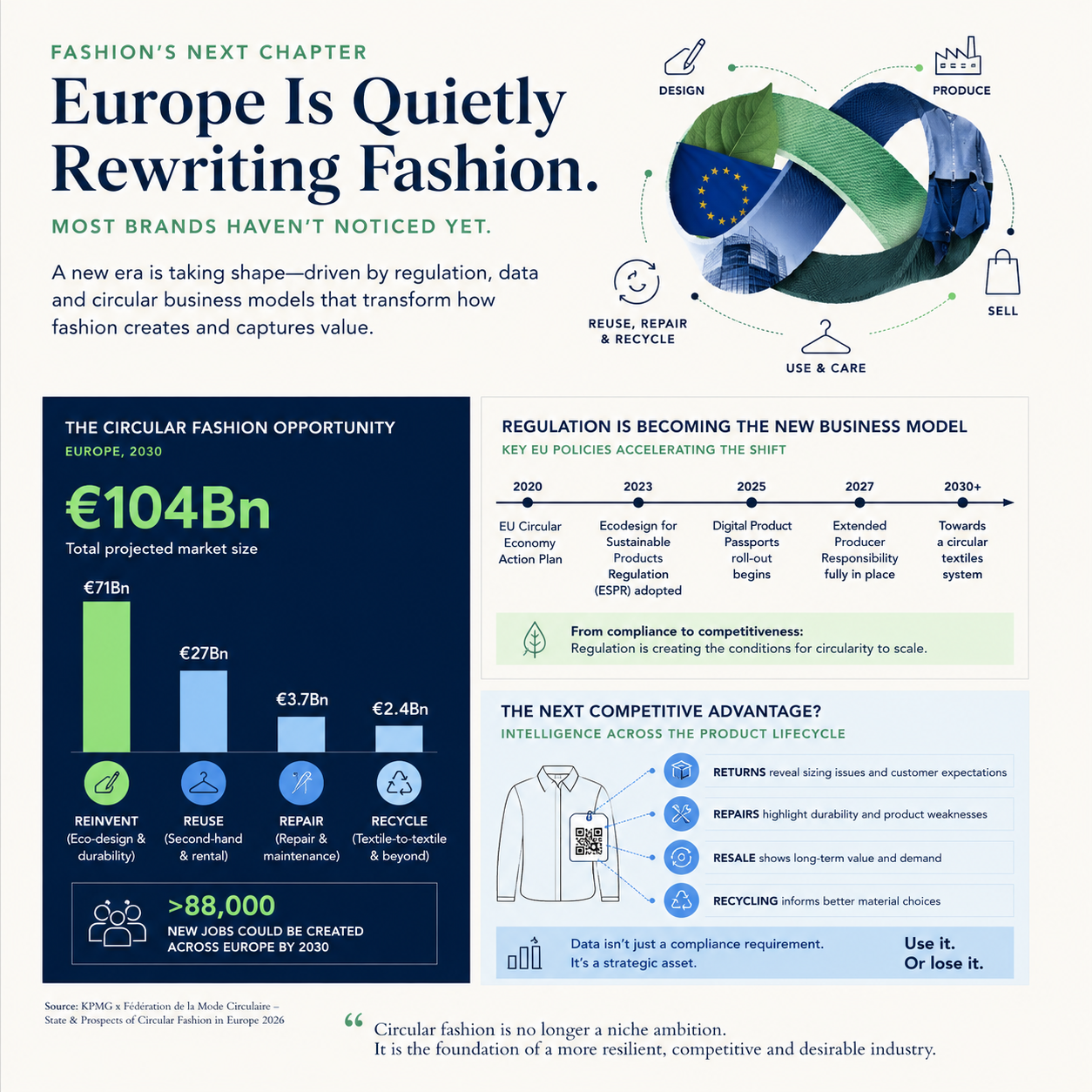
Perhaps the most overlooked message in the report is that regulation is no longer simply about compliance. It is becoming an economic framework. The combined impact of the Ecodesign for Sustainable Products Regulation (ESPR), Digital Product Passports (DPP), Extended Producer Responsibility (EPR), mandatory textile collection, repair initiatives and the upcoming Circular Economy Act is creating something much bigger than a list of legal obligations.
Together, these policies encourage businesses to rethink how products generate value throughout their entire lifetime—not only at the point of sale. Rather than treating repair, reuse and recycling as downstream activities, Europe is steadily moving them closer to the centre of business strategy. The report identifies regulation not as a constraint on growth, but increasingly as one of its key enablers - creating stronger incentives for better product design, greater traceability, improved resource efficiency and new circular business models. This represents a significant shift in thinking. Five years ago, sustainability was largely voluntary. Today, the foundations of a new industrial framework are quietly being built around it.

The Numbers Tell a Bigger Story
One of the strongest aspects of the report is its economic perspective. According to KPMG and the Fédération de la Mode Circulaire, Europe’s four major circular fashion pillars could collectively represent a market of approximately €104 billion by 2030. Perhaps surprisingly, the largest opportunity is not recycling. It is “Reinvent”- designing products differently from the outset through eco-design, durability and circular product development-projected to reach approximately €71 billion. By comparison:
- Reuse: approximately €27 billion
- Repair: approximately €3.7 billion
- Recycling: approximately €2.4 billion
Collectively, these activities could support more than 88,000 jobs across Europe.
These projections challenge many of the assumptions that still dominate public discussions around circular fashion. While recycling often receives the greatest public attention, the report suggests that the largest economic value will be created much earlier in the product lifecycle—through smarter design decisions, improved durability and operational models that prevent waste before it occurs. In other words, the future of circular fashion may depend less on managing waste and more on avoiding it altogether.
Circularity Still Has One Major Obstacle: Execution
Despite its optimism, the report is refreshingly honest about the barriers that remain. Circular business models continue to struggle with fragmented infrastructure, inconsistent economics and limited industrial capacity.
Textile-to-textile recycling, for example, still faces considerable challenges related to feedstock quality, investment requirements and long-term profitability. Likewise, repair networks, reverse logistics systems and material recovery processes require far greater coordination than many current supply chains were originally designed to support. This is an important reminder. Technology alone will not solve circularity. Neither will regulation. The greatest challenge is operational. Building circular systems requires businesses to rethink how products move, how information flows between stakeholders and how value is created across multiple product lifecycles—not just one. That transformation is considerably more complex than launching another sustainability initiative.
My Perspective: The Next Competitive Advantage Will Be Built After the Sale
What struck me most while reading the report was not any single statistic or regulation, but the pattern that emerged across all of them. Whether the discussion focused on eco-design, Digital Product Passports, repair ecosystems or Extended Producer Responsibility, the underlying challenge remained remarkably consistent: the industry still has very limited visibility into what happens to products once they leave the point of sale. For decades, fashion has been optimised around getting products to the customer as efficiently as possible. Entire organisations, technologies and supply chains have been designed to support that journey. Yet the journey back—from returns and repairs to resale, refurbishment and recycling—has often remained fragmented, manual and largely disconnected from strategic decision-making. As circular business models continue to mature, that imbalance is becoming increasingly difficult to ignore. Every interaction after the initial purchase generates information that extends far beyond logistics. Returns reveal recurring sizing issues and changing customer expectations. Warranty claims expose weaknesses in product quality and manufacturing. Repair histories provide insight into durability, while resale performance offers a new perspective on long-term product value. Individually, these signals may appear operational. Collectively, they represent one of the richest sources of intelligence available to any fashion business. This is why I believe the next phase of circularity will be driven less by collecting more information and more by understanding how to use it. The organisations that succeed will not necessarily be those with the most sustainability initiatives or the most sophisticated compliance programmes. They will be the ones capable of connecting data across the entire product lifecycle and transforming it into better decisions-whether that means improving future collections, reducing returns, designing more durable products or allocating inventory more intelligently. In many ways, the conversation is already beginning to shift. Circularity is no longer simply about extending the life of products; it is about extending the value of the information those products generate throughout their lifetime. As regulatory expectations continue to increase, I believe the companies that view product lifecycle data as a strategic business asset—rather than a reporting obligation—will be significantly better positioned to compete over the coming decade.
The Bigger Question
If Europe is quietly redesigning fashion around product lifecycle management rather than product ownership, perhaps we’re asking the wrong question. Instead of asking: “How can we become more circular?” perhaps business leaders should be asking:
- Are we redesigning our organisations - or simply adapting to new regulations?.
- Are we treating product data as a compliance requirement or as a strategic business asset?.
- And when every brand has access to similar regulations, similar technologies and similar sustainability commitments, what will ultimately create competitive advantage?.
My belief is that it won’t be compliance alone. It will be the ability to understand products—not only before they are sold, but throughout everything that happens afterwards.
Because Europe’s biggest fashion transformation isn’t about making better products. It’s about building better systems around them.
Anna Warchalowska is CEO and co-founder of CIRQUEL. If you are a brand, investor or partner interested in circular fashion, sustainable returns, or commercial partnerships, we would love to connect at cirquel.co.